Views: 0 Author: Site Editor Publish Time: 2026-08-05 Origin: Site
Composite decking is not one uniform product. Two boards may both combine wood fibre and polymer, yet their surface construction can lead to different performance, appearance and maintenance requirements. One of the most important distinctions is whether the board is capped or uncapped.
Capped composite decking has an engineered protective layer bonded around some or all of the composite core. Uncapped decking exposes the blended core at the walking surface. Both can create a usable outdoor deck, but they respond differently to stains, moisture, ultraviolet exposure and everyday wear. Understanding that difference helps buyers look beyond colour samples and compare what they are actually purchasing.
The cap is commonly produced through co-extrusion, where the core and protective outer material are formed together. This is not simply paint or a coating applied after manufacturing. A well-made cap is integrated with the board and designed to provide a denser barrier between the environment and the wood-plastic composite beneath.
Depending on the product, the cap may cover the top and sides, wrap all four sides or be applied differently across the profile. Full coverage can help protect the core at exposed surfaces, while the board ends still require appropriate detailing. Buyers should ask for a cross-section and confirm exactly where the protective layer is present.
A cap cannot compensate for poor core formulation, inconsistent manufacturing or an unsuitable structural profile. Board stiffness, fastening behaviour and dimensional stability depend on the complete product. Compare the cap, core, wall thickness, internal structure and technical guidance together rather than treating “capped” as a complete quality guarantee.
Uncapped boards expose the composite blend. Earlier generations of composite decking commonly used this construction, and it remains available in some markets because it can provide a cost-effective, low-splinter alternative to timber.
The exposed surface may absorb or retain staining substances more readily than a capped product. Colour change from weathering can be more noticeable, particularly during the early period after installation. The board may also require faster attention to food, oil and organic residue.
That does not make every uncapped board unsuitable. It may perform adequately in a lightly used, covered or budget-sensitive application when expectations are realistic. Product quality varies, and some owners appreciate a more matte, composite appearance. The key is to understand that maintenance and visual ageing may not match a premium capped board.
A covered balcony with limited weather exposure, a secondary walkway or a project where initial price is the dominant constraint may justify evaluation of an uncapped option. Before choosing it, compare warranty terms, stain guidance and installed examples. The lowest purchase price should not be the only factor if the deck will face barbecue grease, pool chemicals or intense sun.
The cap is designed to improve resistance to common outdoor challenges. A less porous surface is generally easier to wash, and spills have less opportunity to penetrate when they are removed promptly. Pigments and ultraviolet stabilisers in the outer layer can also support more controlled colour retention.
Capped boards often provide more detailed woodgrain patterns and multi-tonal colours because the visible layer is engineered separately from the structural core. This gives manufacturers greater control over texture and appearance. For homeowners seeking a consistent architectural finish, that design flexibility is a significant advantage.
Even a capped surface can be marked by grease, paint, rust, adhesive or prolonged contact with contaminated water. Clean spills early and use approved products. Mats, rubber backing and metal furniture can sometimes cause discolouration or trap moisture, so accessories should be selected carefully.
Likewise, fade resistance does not mean there will be no colour change. Most outdoor materials experience some weathering. Ask how the manufacturer describes the initial stabilisation period and whether samples or display decks show the expected long-term tone.
Australian decks may experience heavy rain followed by strong sun, coastal salt, pool water and high ultraviolet exposure. A cap provides another line of defence against surface moisture and weathering, making capped products attractive for exposed residential spaces.
Installation remains essential. Water can enter cut ends or collect around poor detailing. Boards must be spaced and ventilated according to the technical guide. Sealing the entire structure without drainage is not a substitute for a protective cap; it can trap moisture and create other problems.
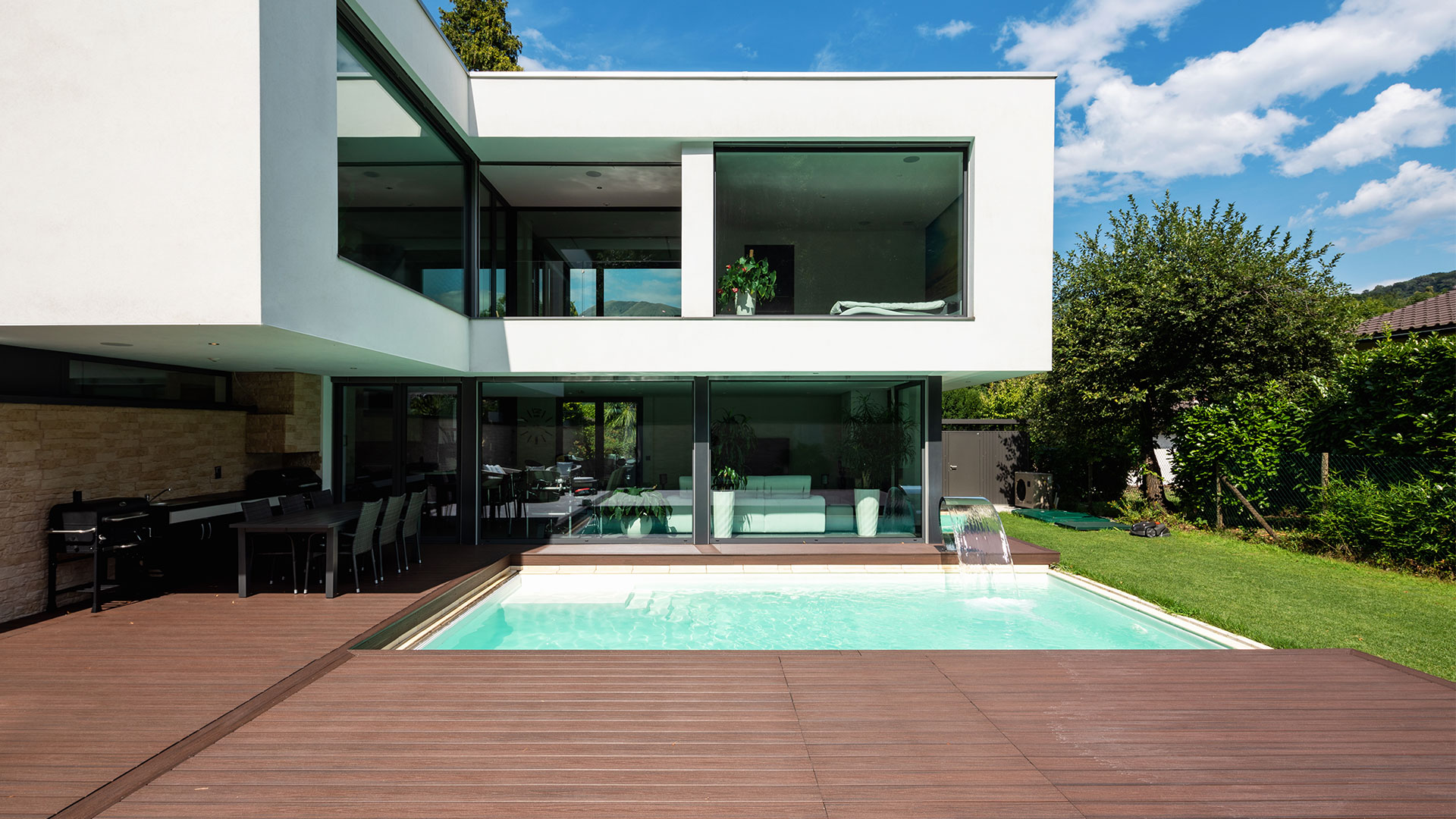
For pool surrounds and uncovered decks, evaluate slip performance as well as moisture resistance. A cap may carry the texture that provides grip, but dirt and sunscreen can still make the surface slippery. Cleaning and drainage should be part of the selection process.
Capped decking is designed to resist everyday wear, but sharp furniture feet, dragged appliances and construction activities can scratch it. Because the cap is visually distinct from the core, a deep scratch may be more noticeable if it penetrates the outer layer.
Uncapped boards do not have a separate shell, yet sanding is not automatically appropriate. Sanding can alter the texture, colour and slip characteristics of any composite board. Repairs should follow the manufacturer’s instructions, and a severely damaged board may need replacement.
Concealed fixing systems create a clean finish, but the deck layout should still allow individual boards to be removed where practical. Breaker boards, picture frames and fixed structures can affect access. Discuss replacement strategy with the installer before outdoor kitchens, balustrades or built-in seating are added.
Capped boards often carry a higher purchase price because of the additional material, manufacturing process and surface design. The relevant comparison is not only the cost per lineal metre. Consider profile width, required joist spacing, fasteners, trims, waste and labour.
Whole-of-life value may favour capped decking in exposed or stain-prone areas because the surface is easier to maintain and designed for stronger colour and stain resistance. Uncapped boards may remain economical where exposure and appearance expectations are modest. A premium is worthwhile only when the performance benefits match the project.
Ask the supplier to explain the board cross-section. Confirm whether the cap covers one, three or four sides and whether the same cap is used on every colour. Review slip test information, warranty exclusions, cleaning guidance and installation details. Look at full-length boards, because pattern variation and straightness are difficult to judge from a small sample.
Check how the profile is constructed. Solid, hollow, arch-shaped and round-hole designs can influence weight, stiffness and fastening, but profile names alone do not establish quality. The complete Composite Decking system should suit the joist layout, span, edge details and expected traffic.
For an exposed family deck, pool surround or outdoor dining area, capped decking is usually the stronger candidate because these spaces face spills, sun and frequent cleaning. For a covered, low-traffic platform with a strict budget, an uncapped product may be considered if its limitations are acceptable.
Commercial and multi-residential projects require a broader review. Slip classification, fire requirements, structural design, accessibility and documentation may influence the decision. The surface construction is only one part of compliance.
Choose capped composite decking when you prioritise easier cleaning, improved resistance to stains and weathering, and a more refined surface appearance. Choose uncapped decking when budget is the main constraint, exposure is limited and you accept more visible ageing or maintenance attention. In both cases, product quality, correct framing and installation discipline remain essential.
WoodVance focuses on advanced co-extruded decking options with protective surfaces, varied textures and board structures developed for Australian outdoor conditions. By examining samples and technical details with WoodVance, homeowners, designers and installers can compare the construction behind each finish and select a system that suits the site, usage level and long-term expectations.